Color Season Analysis Steps to Pick the Right Lipstick Shade at Home
You already know your color season — from professional draping, a color analysis app, or an online session — and now you want lipstick shades that actually belong on your face. The good news: you do not need to start over. This guide gives you a repeatable, at-home process for turning the color season analysis steps you already completed into a small, confident lipstick shortlist.
One important note before we begin: lipstick is an output of color analysis, not an input. A single lipstick shade cannot reliably tell you your season. Color analysis reads your skin, hair, and eyes together as one picture, so treat any existing result as your starting point and use lipstick only to apply that result.
Start with the season result you already have
Pull up the result you already received: your season family (Spring, Summer, Autumn, or Winter), your sub-season if your analysis used one (for example, Soft Summer or Bright Spring), and any palette or recommended-shades list that came with it. This is your map, and the whole process below is just navigation.
If you have a 12-season result, note which of the three dimensions your sub-season name emphasizes — light, deep, soft, bright, warm, or cool. That single word tells you what to prioritize when you look at lipsticks, because each sub-season's palette leans on one dimension more than the others while still combining all three.
Translate your result into three lipstick dimensions
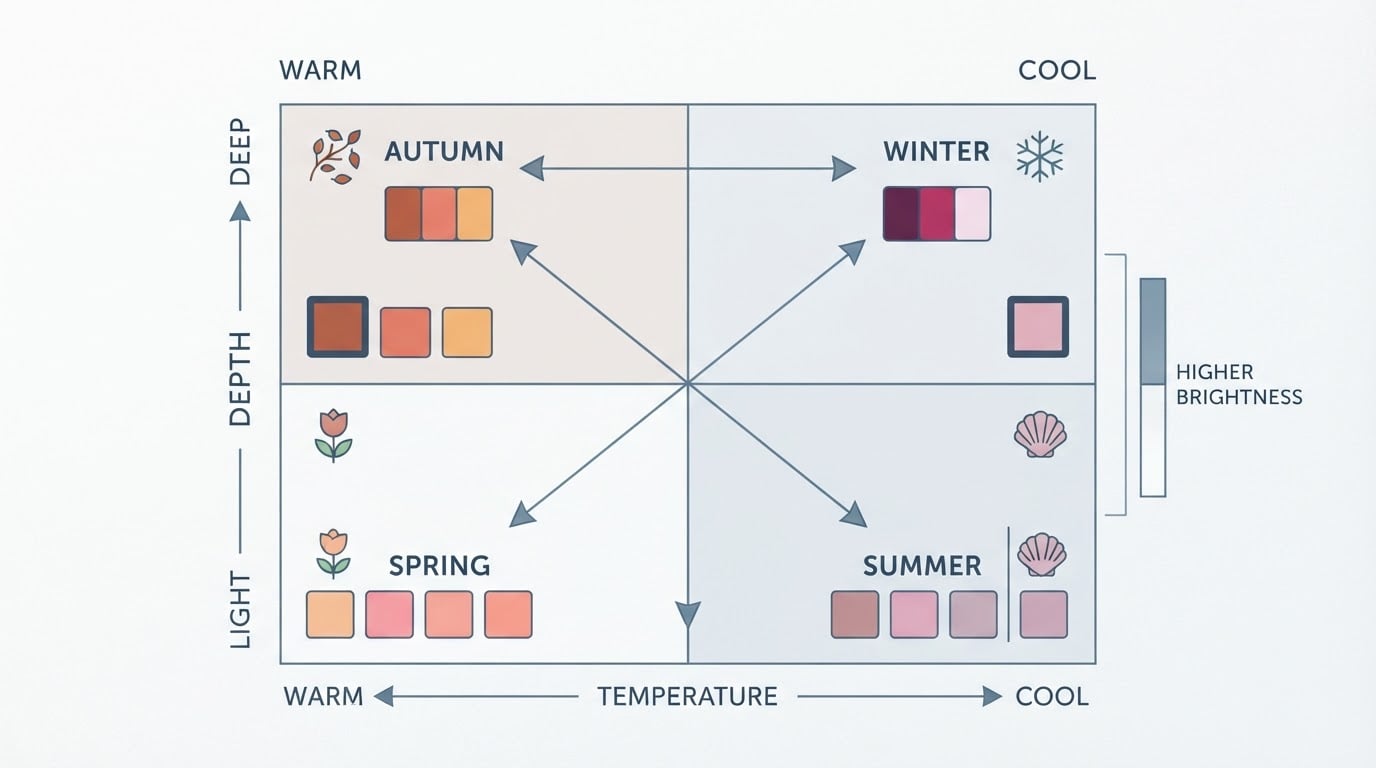
Every lipstick shade can be described with the same three dimensions that color analysis uses, which makes comparing products much easier than memorizing color names. Professional color analysts describe these as hue, value, and chroma, but for lipstick shopping you can think of them as temperature, depth, and brightness or softness:
Dimension | What it means | What it looks like in a lipstick |
|---|---|---|
Temperature | Whether a color reads warm, cool, or neutral | Warm shades have yellow, orange, or peach bases; cool shades have blue, pink, or berry bases; neutral shades sit in between |
Depth | How light or dark a color is | From pale nudes through mid-tones to deep berry, wine, and espresso shades |
Brightness or softness | How clear and vivid versus how muted and greyed a color is | Clear, saturated shades on one end; dusty, smoky, or soft-focus shades on the other |
As color analyst Cate Linden explains in her guide to hue, value, and chroma, value is how light or dark a color is, chroma is how intense or greyed it is, and no single dimension tells the whole story of a flattering color. A muted shade can still be too dark, and a light shade can still be too bright. When you look at a lipstick, ask three questions: Is it warm, cool, or neutral? Is it light, medium, or deep? Is it clear, or soft and muted? Match all three answers to your season, not just one.
Review flexible lipstick families for each season
These are starting points, not rules. Season systems, product lines, and individual preferences vary, so read each family as a direction to test rather than a shopping list to obey.
Spring (warm, lighter, and clear-leaning). Spring coloring tends to suit shades with warmth and brightness: peachy corals, warm pinks, and nudes with a peach or caramel base rather than a pink one. If your sub-season is Light Spring, lean lighter; if it is Bright Spring, you can go clearer and more saturated.
Summer (cool, lighter, and soft-leaning). Summer palettes favor cool, gentle shades: soft mauves, rose and berry-rose tones, dusty pinks, and blue-based reds worn in softer versions. Soft Summer is the most muted end of this range, so dusty, greyed-rose shades tend to harmonize better than stark brights.
Autumn (warm, deeper, and muted-leaning). Autumn coloring typically harmonizes with earthy warmth: terracotta, brick red, warm rosewood, burnt sienna, and brown-based nudes. Deep Autumn can carry richer, darker versions of these, while Soft Autumn does best keeping them muted.
Winter (cool, deeper or clearer). Winter palettes run cool and strong: blue-based reds, berry, plum, wine, and cool bright pinks. Dark Winter can go deep and rich, while Bright Winter can carry vivid, saturated shades that would overwhelm softer seasons.
Lipstick guides that match shades to undertone follow the same logic: warm undertones suit peach, coral, and warm red shades, while cool undertones suit berry, mauve, and blue-based reds, as Palette Hunt's lipstick shade guide summarizes. Your season result simply tells you which undertone family you belong to and how light, dark, bright, or soft to keep it.
Account for neutral seasons and differences between systems
Not every result fits neatly into one of the four families. Neutral-leaning seasons — and some sub-seasons that sit between families — can borrow from both sides in moderation. Rose-based nudes, dusty mauve, and balanced true reds are common safe ground for neutral coloring, while extreme warm or extreme cool shades are where things start to look off.
Systems also disagree in naming and granularity. Some analysts use the classic four seasons, others split each into three sub-seasons for a 12-season system, and still others use 16 or more. As one professional color studio explains in its complete guide to seasonal color analysis, the four-season system gives useful broad strokes, while the 12-season system adds precision that helps people with neutral undertones or mixed features. If your result card says something different from a friend's card from another studio, that does not mean one of you is wrong — it means the systems differ. When in doubt, go back to the three dimensions and test.
Shortlist shades using descriptions and swatches
Before you test anything, build a working shortlist of three to six shades from product descriptions and online swatches. Learn to read the descriptor language: "blue-red," "warm coral," "brown-based nude," and "dusty rose" tell you more than a shade name like "Paris" or "Flamingo" ever will.
Remember that shade names vary by brand and display: the same name can mean different colors in different lines, and screens show color differently depending on calibration, brightness, and viewing angle. Treat online swatches as a hypothesis about the color, not a guarantee, and carry your shortlist to the comparison step below.
Set up a consistent at-home comparison
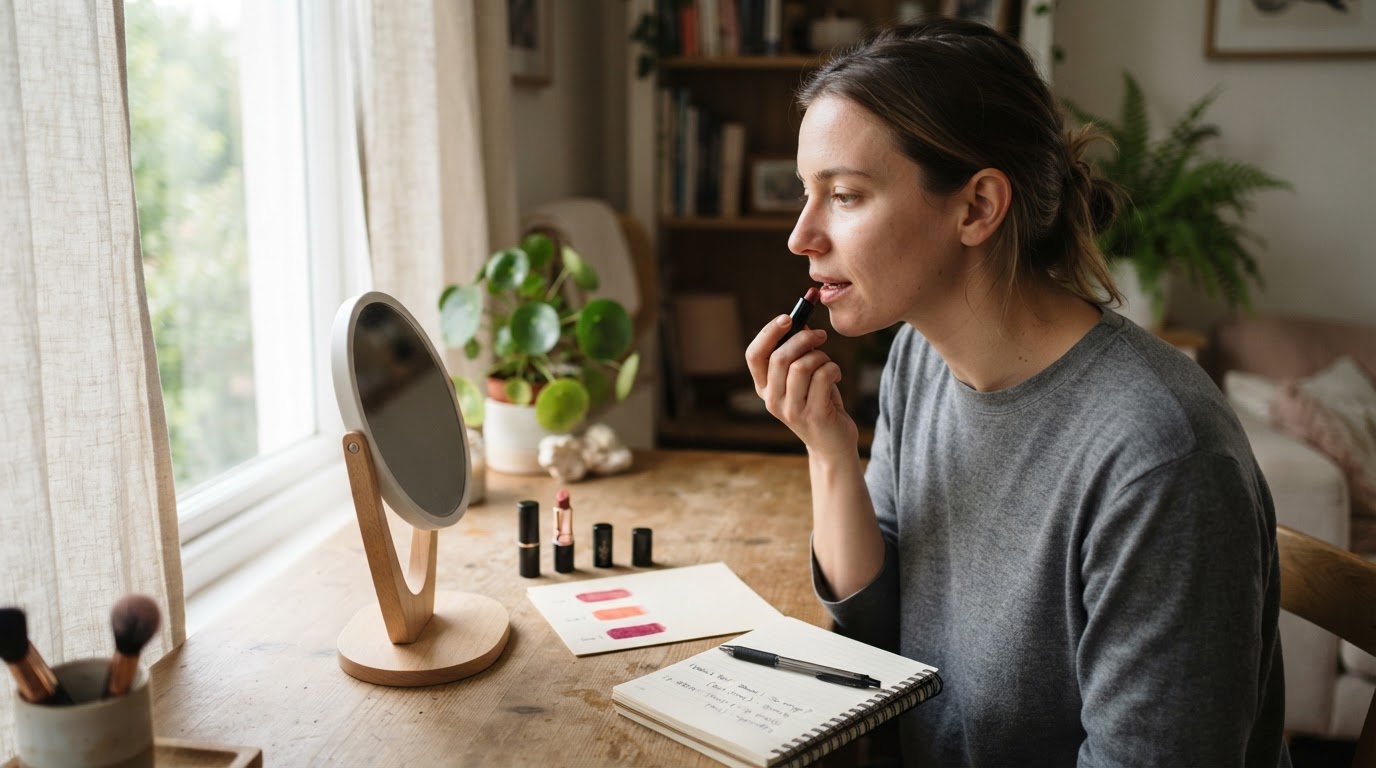
Testing several shades fairly is mostly about keeping everything else constant. Choose a spot with soft, indirect daylight — near a window, but not in direct sun — and test at roughly the same time of day each session. Avoid judging colors under a single overhead bulb, which adds its own warm or cool cast.
Keep the surroundings consistent too. Wear the same neutral top or drape a plain white or grey cloth around your shoulders, remove distracting jewelry, and keep your skin bare of other makeup for the first pass. Apply each shade to clean lips as a separate swatch — wipe and re-apply between shades rather than layering — then blot and give the color a minute to settle before you judge it. Judge one shade at a time against your face, then compare your notes afterward rather than your memory.
Compare shades with your outfit and makeup
A lipstick never sits on your face alone, so make the final call in context. Put on the outfit you plan to wear, or at least hold its main color near your face, and test your shortlist against it. A simple rule that works in most cases: if your outfit is warm-toned, wear a warm lipstick; if it is cool-toned, wear a cool one; when in doubt, a neutral rose or your everyday nude works with almost anything, as Palette Hunt's guide notes. Consider your other makeup the same way — a warm coral lipstick will fight a cool-toned foundation or blush no matter how well it matches your season on its own.
Record preferred shades and near-misses
Keep a small personal shopping note, in your phone or a notebook, with one line per shade you tested. For each shade, record the brand and exact shade name, the finish (matte, satin, sheer), and your three-dimension read: temperature, depth, and brightness or softness. Then note how it looked: which outfit you tested it with, whether it brightened or washed you out, and whether it lasted the way you wanted.
Write down near-misses too — they are as useful as wins. A shade that turned too brown, washed out too pale, or pulled unexpectedly cool on your lips is a data point that saves you the same mistake in another brand. Over time this note becomes your personal lipstick reference, which is far more reliable than a shade name you vaguely remember liking once.
Troubleshoot shades that look different in real life
It happens to everyone: the shade looked perfect online, fine in the tube, and different on your lips. Usually one of these is at play:
- Screens are not calibrated. Online swatches depend on the photographer's camera and your screen's settings, so expect drift.
- Packaging and store lighting lie. Fluorescent store light adds its own cast; step near a window before deciding.
- Your lips change the color. Natural lip pigmentation shows through sheer formulas, so a shade can look deeper or pinker on you than on the swatch card.
- Formula matters as much as color. The same pigment reads differently matte, satin, glossy, or sheer.
When a shade surprises you, test it once more in daylight with clean lips before crossing it off. If it still misses, add it to your near-miss notes and move on.
Test safely and follow product instructions
When you test shades in a store or from shared testers, practice basic hygiene: never apply directly from the tester tube, use a fresh disposable applicator or ask for a clean swatch, and wipe the tester surface before and after use. Follow the manufacturer's directions on every product you try, and stop using anything that irritates you. This guide offers color-matching process only — it makes no safety, accuracy, or appearance guarantees.
No season result yet? Run the free Tone & Fit analysis
If you reached this guide without a color-season result, do not try to reverse-engineer one from a lipstick. Tone & Fit's free analysis takes a selfie or uploaded photo and measures undertone (warm versus cool), value (light versus deep), and chroma (muted versus bright) to return a 12-season match such as Deep Winter or Muted Autumn in about 30 seconds, with no account and no quiz. Once you have that result, come back to these steps and build your lipstick shortlist on a foundation you can trust.
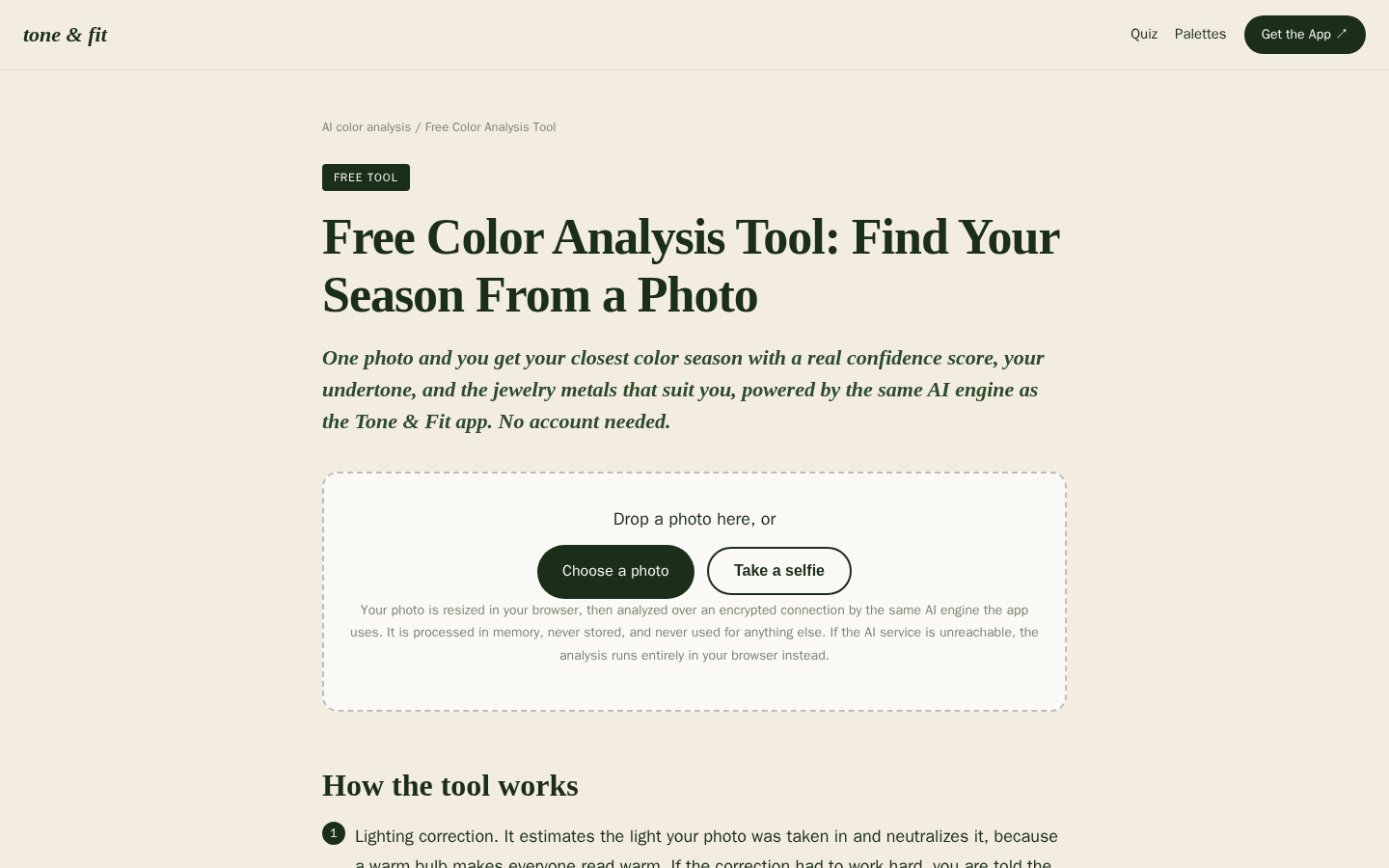
Desktop first-screen of the free web-based color analysis tool with photo upload drop zone, how-it-works steps, and privacy notes