Why blush shows a mismatch faster than anything else in your makeup bag
Blush sits on bare skin, in the middle of your face, next to your eyes and hair. That is a hostile test environment. A foundation that is half a shade off can disappear under concealer; a blush that is half a shade off reads as sunburn, fever, or an ashy patch.
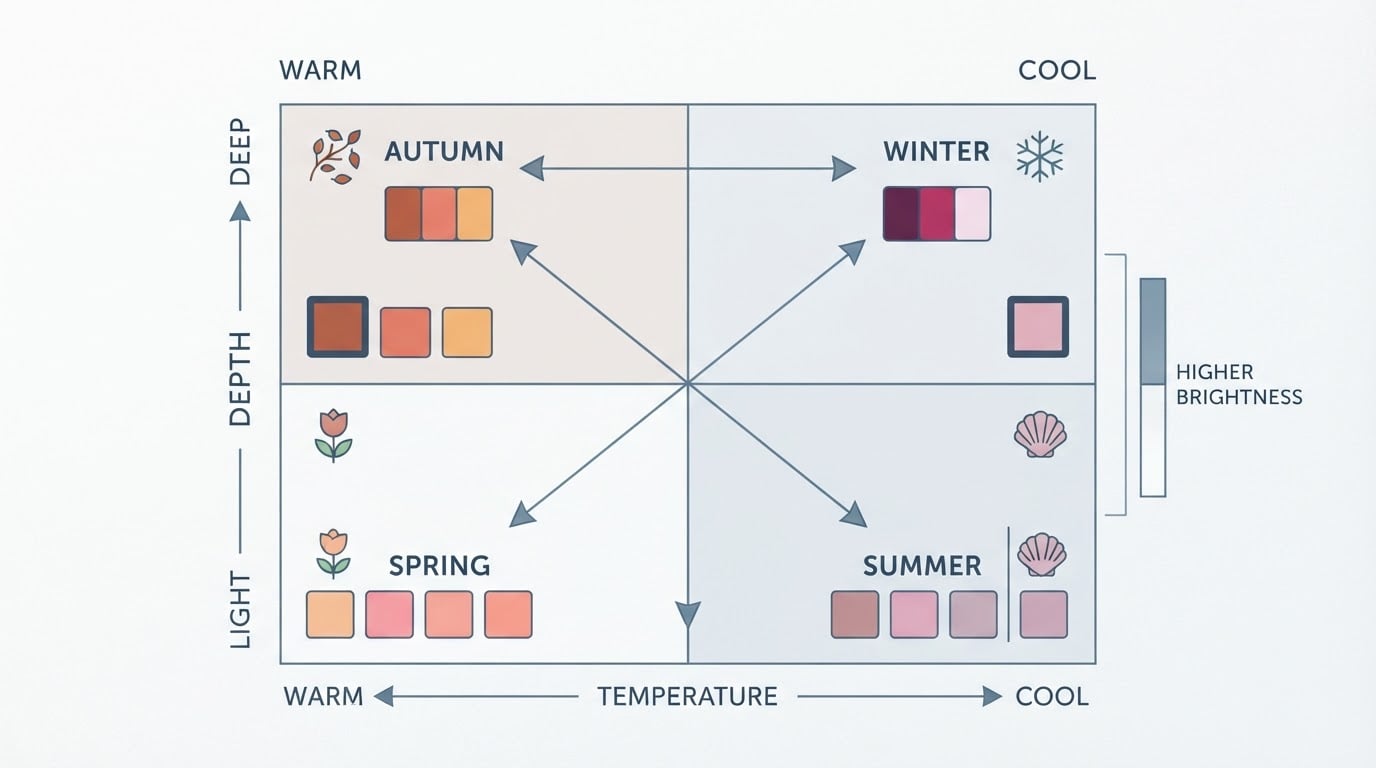
Personal color analysis sorts people into season families using three measurements. Undertone is warm, cool, or neutral. Value is how light or deep your natural coloring is. Chroma is how muted or bright it is. Every blush carries the same three properties, and the goal is not to match your skin tone exactly. It is to match the direction your season leans on all three axes.
That is why blush colors by color season are simpler than they look: you are not choosing "a pink" or "a coral," you are choosing a color whose temperature, depth, and brightness agree with yours.
The four blush families at a glance
Season family | Temperature | Depth | Brightness | Blush shades that read right | Shades that usually fight |
|---|---|---|---|---|---|
Spring | Warm | Light | Clear | Peach, apricot, coral, warm pink | Cool mauve, greyed rose, blackberry |
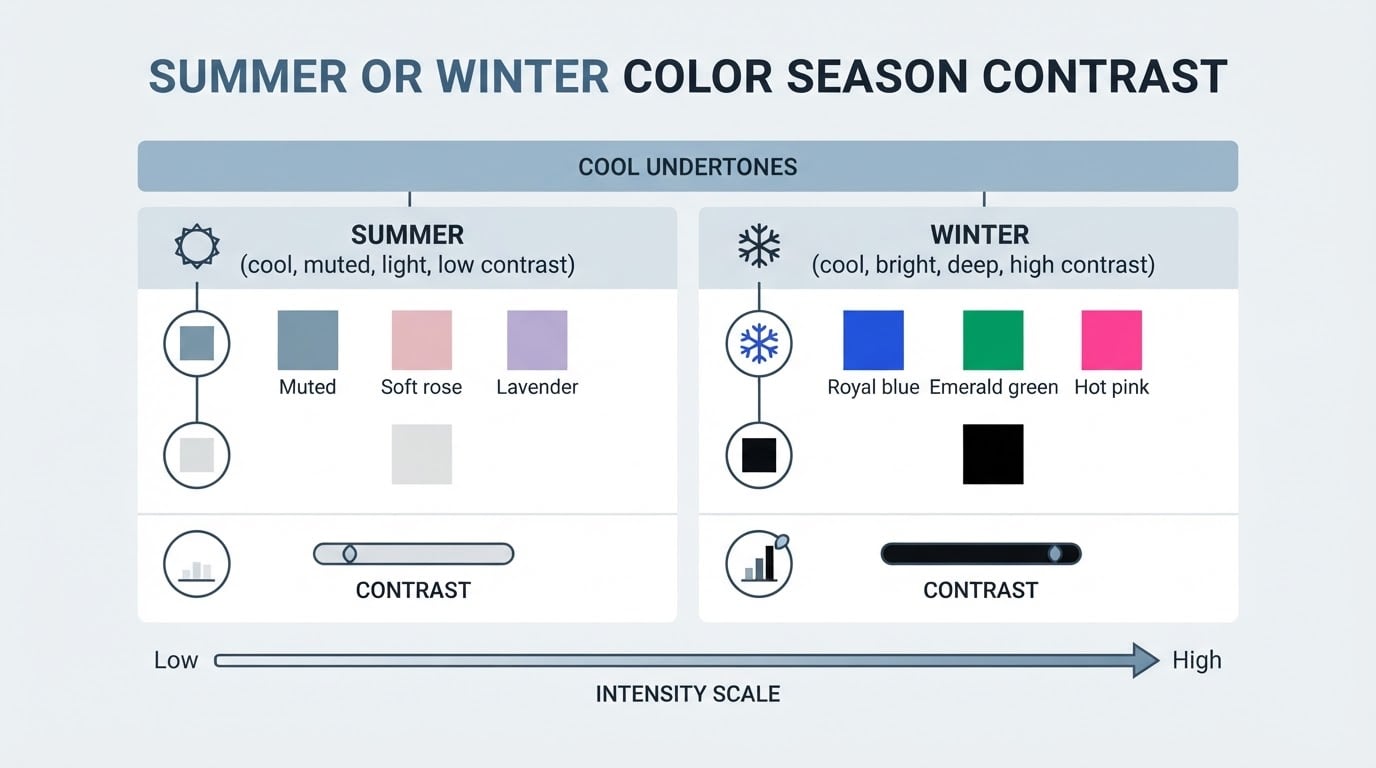
Summer | Cool | Light | Muted | Dusty rose, soft rosewood, cool pink | Orange, brick, bright fuchsia |
Autumn | Warm | Deep | Muted | Terracotta, warm brick, toasted pecan | Cool candy pink, icy fuchsia |
Winter | Cool | Deep | Bright | True berry, cool plum, raspberry | Peach, apricot, dusty brown-rose |
Two diagonals explain the table. Springs and Autumns share warmth; Summers and Winters share coolness. Springs and Summers share lightness; Autumns and Winters share depth. Brightness cuts across both groups: Springs and Winters are the high-clarity families, Summers and Autumns are the softened ones.
Spring: warm, light, clear
Spring skin has a sunny, fresh quality. A Spring blush works when it looks like sun on skin rather than a stain sitting on top of it. Peach and apricot are the reliable defaults, with a warm pink for lower-contrast Springs. What ruins a Spring blush is grey: a dusty rose or mauve carries enough blue-grey to make Spring skin look slightly ashen.
Summer: cool, light, muted
Summer coloring is cool and softly blended, and it does not handle saturation well. Dusty rose is the classic Summer blush for a reason. The base is cool, but the pigment is already softened, so it echoes the skin instead of announcing itself. Put a clear, bright pink on a pale Summer and the blush becomes the first thing people see. Put anything orange on Summer skin and the skin around it turns muddy.
Autumn: warm, deep, muted
Autumn is the richest family and the one that can wear bronze-adjacent color. Terracotta, brick, and toasted pecan are legitimate everyday blushes for Autumn, especially on medium and deep skin. The failure mode is rarely "too much color." It is "too little depth." A pale pastel pink sits on the surface of an Autumn face instead of melting into it.
Winter: cool, deep, bright
Winter needs contrast. A berry or plum with real saturation reads as a natural flush on a Winter face; the same product on a Summer face reads as stage makeup. Winters should treat pale pink as a nude rather than a headline shade, and generally avoid peach, because the warmth flattens the cool cast Winter coloring depends on.
How sub-seasons shift depth and brightness
Four families are half the system. The 12-season model gives each family three sub-seasons, and most of the difference inside a family is one variable, not a whole new palette. Keep the temperature; move depth or brightness one step.
Spring
- Light Spring — the lightest, most delicate version: sheer warm pink, softest peach.
- True (Warm) Spring — the warmest: apricot, coral, warm salmon.
- Bright (Clear) Spring — the clearest: cleaner coral, a warmer pink with more chroma.
Summer
- Light Summer — lightest and coolest: cool baby pink, pale rose.
- True (Cool) Summer — the benchmark: dusty rose, soft rosewood.
- Soft Summer — most muted: greyed rose, dusty taupe-pink, muted mauve.
Autumn
- Soft Autumn — muted, medium depth: soft terracotta, dusty warm rose.
- True (Warm) Autumn — warmest: brick, toasted pecan, spiced peach.
- Deep Autumn — deepest: deep terracotta, dark copper, warm plum.
Winter
- Deep Winter — deepest: blackberry, deep berry, dark plum.
- True (Cool) Winter — the coolest: true berry, cool plum.
- Bright Winter — brightest: cool fuchsia, raspberry, clear magenta-pink.
If you know your sub-season, use it. If you only know your family, stay in the middle row — True Spring, True Summer, True Autumn, True Winter — and adjust one step at a time: lighter, deeper, softer, or brighter, until the blush stops looking like a separate object on your face.
A 60-second match test
1. Start with your palette, not the display. Pull the pinks, reds, and oranges out of your season palette first. Those are your temperature anchors; everything else is a depth or brightness adjustment.
2. Compare the pan against the palette, not against your hand. Hand skin is often a different depth from face skin, and store lighting flatters almost everything. Compare the blush to your known palette colors, ideally as a swatch laid on the cheekbone in daylight.
3. Test three adjacent options, not three random ones. Take your anchor shade plus one lighter and one deeper neighbor from the same family. A cool mauve, a bright pink, and a peach are not a controlled test; a dusty rose, a lighter dusty rose, and a deeper rosewood are.
4. Judge the blend, not the color. The right blush disappears into the skin at its edges. The wrong blush leaves a visible border no matter how well you blend, because the color is not sitting in the same temperature plane as your skin.
5. Change one variable at a time. Too orange? Move cooler, not lighter. Too bright? Move muted, not darker. Too heavy? Move lighter, not cooler. Most "wrong" blushes are one variable away from right.
Five mistakes that send people back to the wrong blush
- Matching blush to hair color instead of undertone. Hair changes every few months; undertone does not. A newly coppered brunette with cool skin still needs a cool blush.
- Treating olive as automatically warm. Olive skin runs cool-olive and warm-olive, and that difference decides whether the right blush is dusty rose or terracotta.
- Reading "natural flush" literally. Post-exercise cheek red is circulation, not a pigment match. Chasing it is how people end up in cool candy pinks that do not suit them.
- Applying bronzer logic. Bronzer adds warmth and depth; blush adds the color family. Choosing a brown-rose "because it is subtle" often just gives a muted Season a grey cast.
- Treating a quiz result as final. Question-based quizzes and photo scans are starting points. The last check is always a daylight swatch on your own cheek.
When you already know your season
If your season is settled and you want a reference to check against, one option is Tone & Fit, whose published 12-season palette library lists 72 hex-coded swatches organized by the four season families. Hex codes help with blush because a pan rarely looks the way it did in the package; comparing the code against your season's range replaces guesswork with a value you can verify. The library is free and does not require an account.

Desktop first-screen of the palettes index page showing season families (Spring, Summer, Autumn, Winter) with hex-coded swatches and sub-season links
FAQ
Can I wear a blush from a different season?
Sometimes, but borrow across one axis, not two. A cool Summer can often wear a Soft Autumn rose by taking its muted depth and keeping the temperature cool; she should not jump to a bright coral at the same time. The further a shade sits from your family on both temperature and brightness, the more it will look like a costume.
Should blush and lipstick match exactly?
No. A close family match is usually enough, and a slight depth difference often looks more natural. The pair should agree on temperature and disagree only mildly on depth.
What if I am between two seasons?
Pick the variable you are sure about and treat the other as adjustable. If you know you are warm but not whether you are Spring or Autumn, start with a light terracotta: deepen it if it reads flat, lighten it if it reads heavy.
Does my blush need to change when I change my hair color?
Temperature usually stays put because undertone does not change with dye. Depth and brightness are more flexible: a darker hair color can absorb a deeper blush, and a bleached shade can make a soft blush look stronger than it is.
Is one blush enough for the whole year?
If it sits at your season's center — a true peach for a True Spring, a dusty rose for a True Summer — yes, for most of the year. Sub-season shifts are small adjustments, not a second wardrobe. Two blushes, one for brighter days and one for muted ones, cover almost every situation.
The takeaway
Blush colors by color season are not a list to memorize. They are three questions asked in order: Is the shade warm or cool? Is it light or deep? Is it clear or muted? Answer those against your own season and the correct blush stops being a guessing game.