How to Pick a Hair Color That Fits Your Seasonal Color Palette
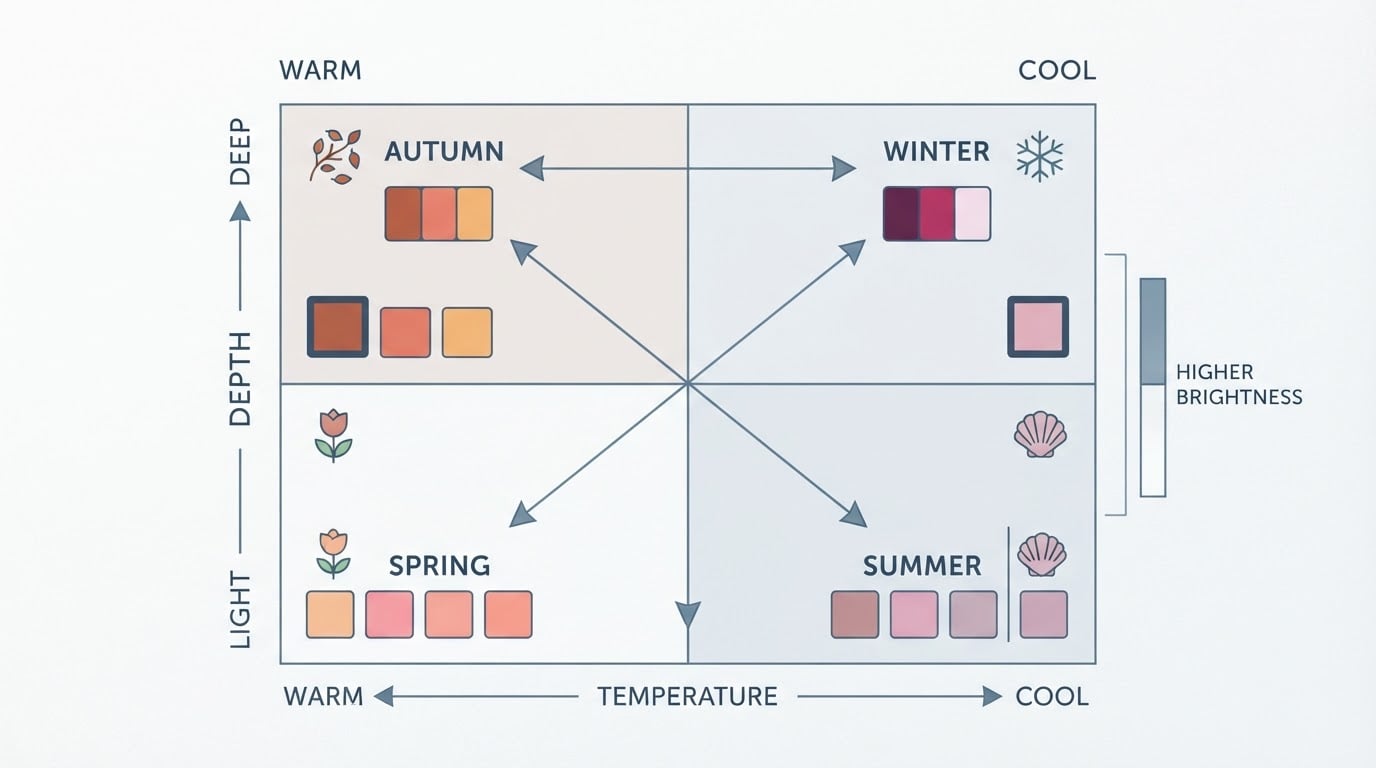
You already did the hard part: your seasonal color result tells you whether your coloring reads warm, cool, or neutral; light, medium, or deep; and muted, balanced, or bright. The question left is practical — how to pick a hair color that fits your seasonal color palette without treating your result like a rigid rule. This guide translates the three dimensions of your palette into hair-color words you can use with a stylist, a swatch book, or a box of color, and it ends with a shortlist you can actually bring to an appointment.
One thing to know up front: there is no single correct hair color for any season. Color analysis describes which shades tend to harmonize with your coloring; it does not override your taste or your right to choose contrast on purpose. If you love a shade outside your palette, that is a valid choice — you are just making it with information instead of guesswork.
Begin with your existing seasonal color result
Pull up the result you already have and write down three things: the season family (Spring, Summer, Autumn, or Winter), the sub-season if your system uses one (for example Soft Summer or Deep Autumn), and the palette's three characteristics — temperature, depth, and intensity. Seasonal color analysis works from the same dimensions most hair-color conversations use. That is why your result transfers: it is not a list of rules but a description of how much warmth, lightness, and clarity your features carry.
If your result only names a season without a sub-season, look at the palette itself. A Soft Autumn palette is muted and blended; a Deep Autumn palette is richer and darker. The palette description, not the label, is what you translate.
Translate palette temperature into hair-color descriptors
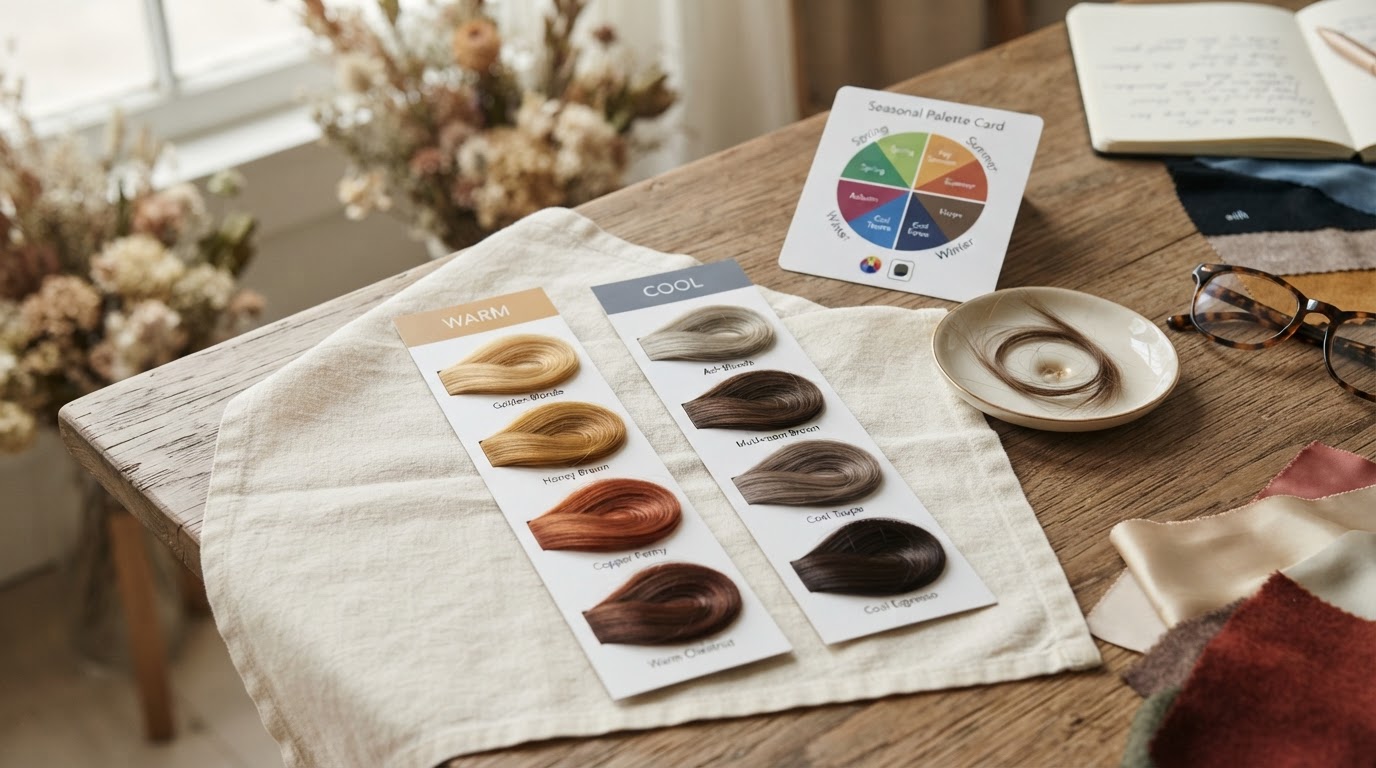
Temperature is the easiest dimension to translate because hair-color vocabulary already uses it. In professional shade coding, warm tones are described with words like gold, copper, and auburn; cool tones with ash, violet, and beige; and neutral tones sit between the two. Your palette points in one direction:
- Warm-leaning palettes (typical of Spring and Autumn families) pair naturally with descriptors such as golden, honey, copper, caramel, and warm chestnut.
- Cool-leaning palettes (typical of Summer and Winter families) pair naturally with ash, mushroom, cool taupe, beige-blonde, and cool espresso.
- Neutral-leaning palettes work with balanced descriptors: soft beige, greige, neutral brown, and shades described as showing no visible warmth or ash.
When a stylist asks what you want, these words are more useful than a color name, because "brown" can read warm, cool, or neutral depending on the formula. Say the direction first, then the depth.
Use depth as a range, not a rigid matching rule
Hair-color depth is measured on a 1-to-10 level scale, where level 1 is black and level 10 is the lightest blonde. Level describes only how light or dark a shade is — a level 6 can be golden, ash, copper, or neutral. That separation matters because your palette's depth is a range to work inside, not an exact number to match.
Use your natural color as the anchor. Salon guides suggest that staying close to your natural contrast level usually gives the most seamless result, and your regrowth is the most honest reference you own. If your palette reads light, explore lighter depths; if it reads deep, explore deeper ones. And if you are coloring at home, most box colors change your level by about two steps, and larger moves usually require bleach or a salon — plan the range, not just the dream shade.
Compare muted, balanced, and bright-looking shade directions
Intensity (sometimes called chroma) is the dimension people skip, and it is often the difference between a color that looks intentional and one that looks like a costume. Muted palettes (for example Soft Summer or Soft Autumn) pair most easily with quiet, blended color: single-process shades, soft dimension, and low-contrast combinations. Balanced palettes sit in the middle with medium-saturation browns and blondes. Bright palettes (for example Bright Spring or Bright Winter) can carry clearer, more saturated color and higher contrast between pieces.
Notice what this does not say: muted people can absolutely wear vivid color, and bright people can go soft. It says which direction creates ease — and if you want the opposite effect, you now know exactly what you are asking for.
Hair-color directions for warm, cool, and neutral-leaning palettes
Palette direction | Descriptors to look for | Salon shade words |
|---|---|---|
Warm-leaning | golden, honey, copper, caramel, warm | golden blonde, honey brown, copper or auburn red, warm chestnut, caramel highlights |
Cool-leaning | ash, beige, mushroom, taupe, cool | ash blonde, mushroom brown, cool espresso, violet-brown, pearl or beige dimension |
Neutral-leaning | balanced, soft, low-reflect | neutral brown, soft beige blonde, greige, neutral black |
Every direction can be expressed at any lightness, which keeps the choice inclusive of any natural base: warm can look like golden blonde or warm espresso, cool can look like ash blonde or blue-black, and red, gray, and fashion-color directions all have warm, cool, and neutral versions — copper versus wine-red, honey-blonde versus pearl-blonde blends through gray, and warm coral-pink versus cool violet fashion shades. The descriptors, not the base color, carry your palette.
How highlights, lowlights, and dimensional color change the decision
An all-over single color is only one option, and for many palettes it is not the most useful one. Dimensional color — highlights, lowlights, babylights, balayage, or a gloss — lets you control temperature and depth in separate areas instead of committing the whole head to one formula. Colorists often use lowlights to place depth where the hair would naturally sit darker and highlights to keep lighter pieces from reading flat, which is how a "bronde" can stay in one palette even though it contains multiple shades.
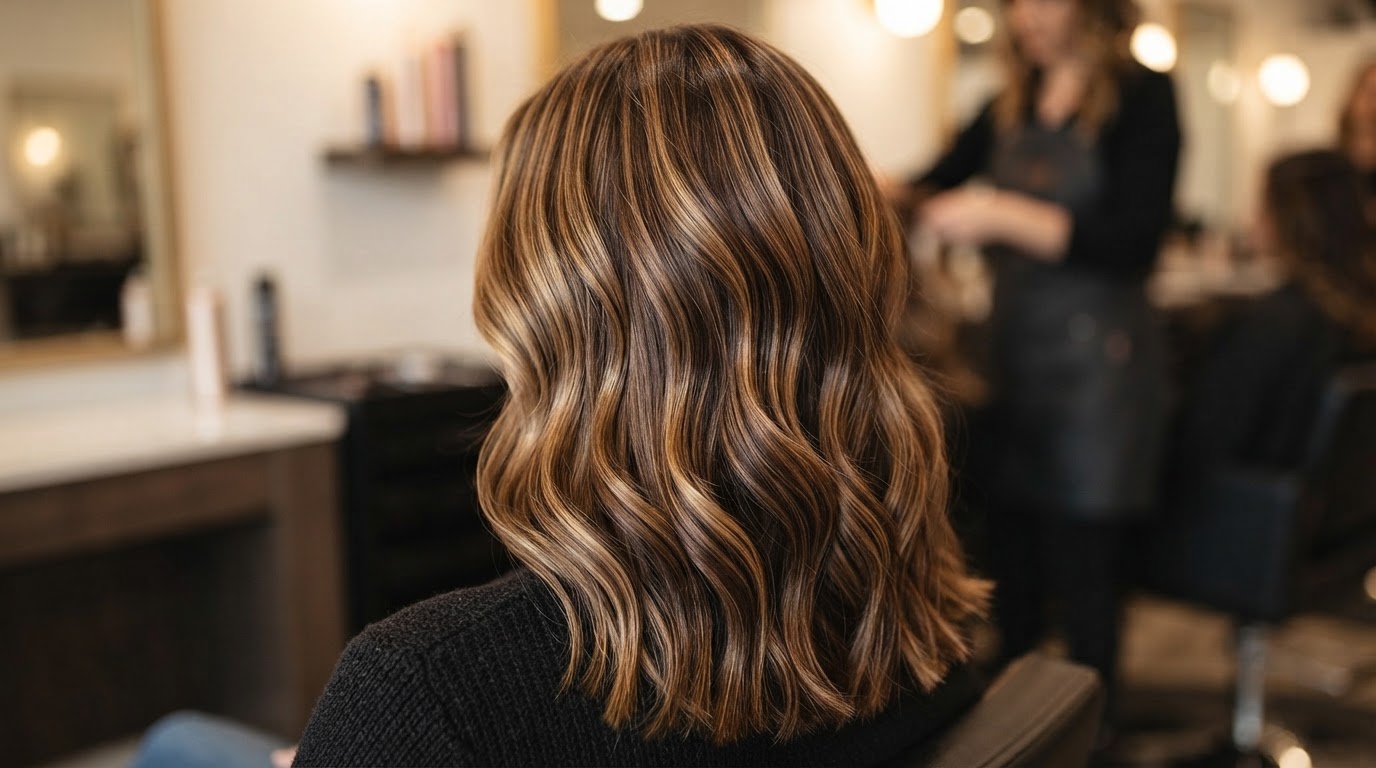
Dimension is also the lower-commitment test: face-framing pieces or a tonal gloss show how a direction reads before you commit to a full formula, and a few bright pieces can make a deliberate statement while the base stays in your range.
Working with natural, dyed, gray, and transitioning hair
Your starting hair changes the conversation, not the palette. Be honest with your stylist — or the box — about which situation you are in:
- Natural hair: your regrowth is your depth reference, and virgin hair is the most predictable canvas for lift.
- Previously dyed hair: existing artificial color does not reliably lift like natural hair does, so a big change may need color removal, a corrective appointment, or a multi-session plan.
- Gray hair: colorists read the level of your remaining pigmented hair separately from your gray percentage, because gray makes the whole head look lighter than its real base. For full coverage, neutral tones close to your natural base are the usual recommendation; to keep or blend gray, dimensional placement and glosses weave your palette's tones through it instead.
- Transitioning: growing out a previous color is a normal phase — a gloss or toner can bridge the two zones while your palette guides the destination.
Follow the product's instructions for at-home color, and leave technically complex steps — heavy lift, corrective work, high-percentage gray — to a professional.
Create a shortlist with swatches and reference photos
Narrow the options to three to five candidates, each written the way a colorist would: direction plus depth, such as "golden, level 7" or "ash, level 5." Then gather evidence for each: real swatches from a salon shade book or professional chart, photos of people with a similar natural base wearing the shade, and your own photos of the color you are considering. Tools like Tone & Fit's AI Hair Studio, described by the company as a virtual try-on with 138 hairstyles and 105 hair colors, let you preview a candidate on your own photo against your analyzed season before you book anything — a useful second opinion, not a substitute for a professional's judgment on your hair's condition.
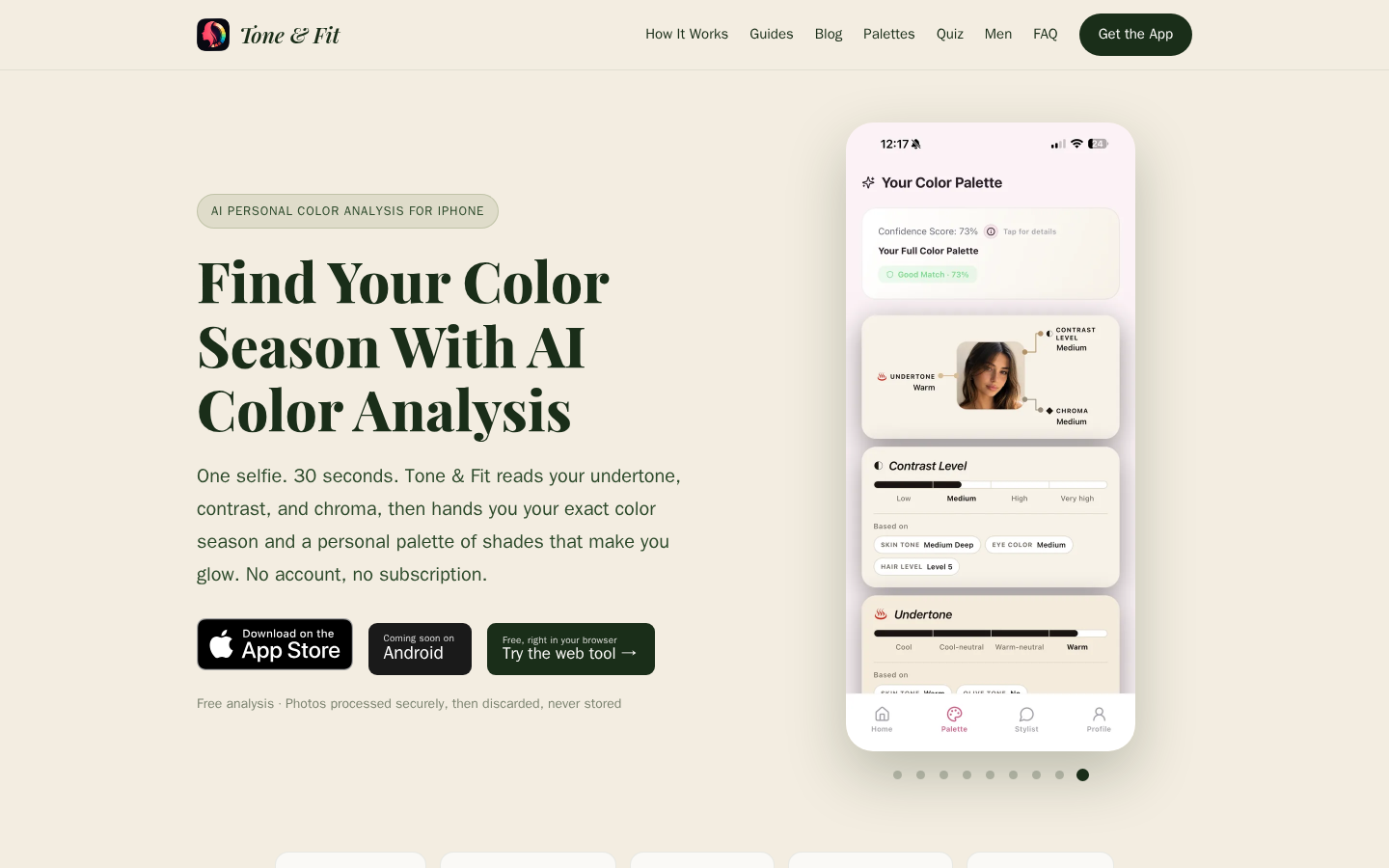
Tone & Fit product interface.
Bring that shortlist to the appointment. Stylists can work with a direction and a depth even when a named shade does not exist in their color line, because the formula is built from those two values.
Questions to take to a professional color consultation
A good consultation is a two-way conversation. Take these questions with you:
- What is my natural level, and how many levels can we realistically move in this session?
- Which tone direction fits my palette — warm, cool, or neutral — and how will you formulate it?
- Should we do a single color or a dimensional plan, and what will each look like over the next few months?
- How will my gray be handled — covered, blended, or left as part of the design?
- What maintenance will this need, and how will it grow out?
If a proposed shade conflicts with your palette, say so — and be equally open to the stylist explaining why the formula needs adjustment. The palette is input to the decision, and the person who sees your hair in person has information your palette does not.
Recheck the result with clothing and makeup colors you already use
After the color is in, the cheapest verification is your own wardrobe. Wear colors you already know work from your palette and look in natural light: does the hair read warm, cool, or neutral next to them? Brassiness is usually the first sign a warm direction drifted; an ash shade that looks flat or grayish may have gone too cool. Small drift is normal and fixable with a toning shampoo or gloss — a full recolor is rarely the first step.
If you have never had your colors analyzed, or you want to recheck your season before a significant change, run the free Tone & Fit color analysis or download the app and confirm your palette first. Then bring your shortlist, your questions, and your own preferences to a qualified colorist — the result belongs to you, and the palette is just the starting point.